


Lighting
In most cases, the graphic is placed on the exterior side of the window where it is exposed to sunlight, with the interior lighting levels lower.
For optimum one-way visibility, lighting should be brighter on the graphics than on the black (unprinted) side. In some cases (e.g., interior store windows in a shopping mall), flood lighting may be needed to illuminate the graphics to prevent the image from looking washed out.
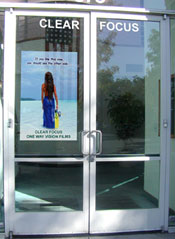 |
Example of adequate lighting: Light is shining directly on the graphics, and the outside lighting |
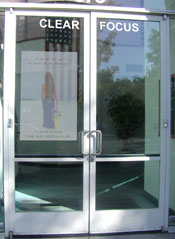 |
Example of less-than-ideal lighting: Image becomes translucent and is more difficult to see. |
Lighting considerations for hospitals and other health-care facilities, correctional facilities, airports, etc.
Thanks to their one-way visibility, our perforated window films have a variety of security applications in locations where controlling visibility is vital. If the film will be used in an interior setting, in particular, we recommend testing it under the exact lighting conditions prior to production/application to ensure it will work as desired.
Theaters and other entertainment venues
CLEAR FOCUS films can be used like scrims by changing the lighting level to achieve the desired see-through effect. Note that pressure-sensitive films have a release liner that must be removed and the film must be attached to a sheet of glass, clear Plexiglas or other optically clear panel to obtain the see-through effect.
Residential use
CLEAR FOCUS films are also suitable for residential use where they provide privacy and insulation, reduce glare, and protect furniture, drapes and carpets from the sun — all without blocking the view or darkening the room.
Ideal for sliding glass doors and windows, kitchen and family-room windows, etc.
Important: At night, when the illumination level is brighter inside the house than outside, it will be possible to see through the film into the interior of the house. For this reason drapes or window blinds may still be needed to provide the desired privacy.